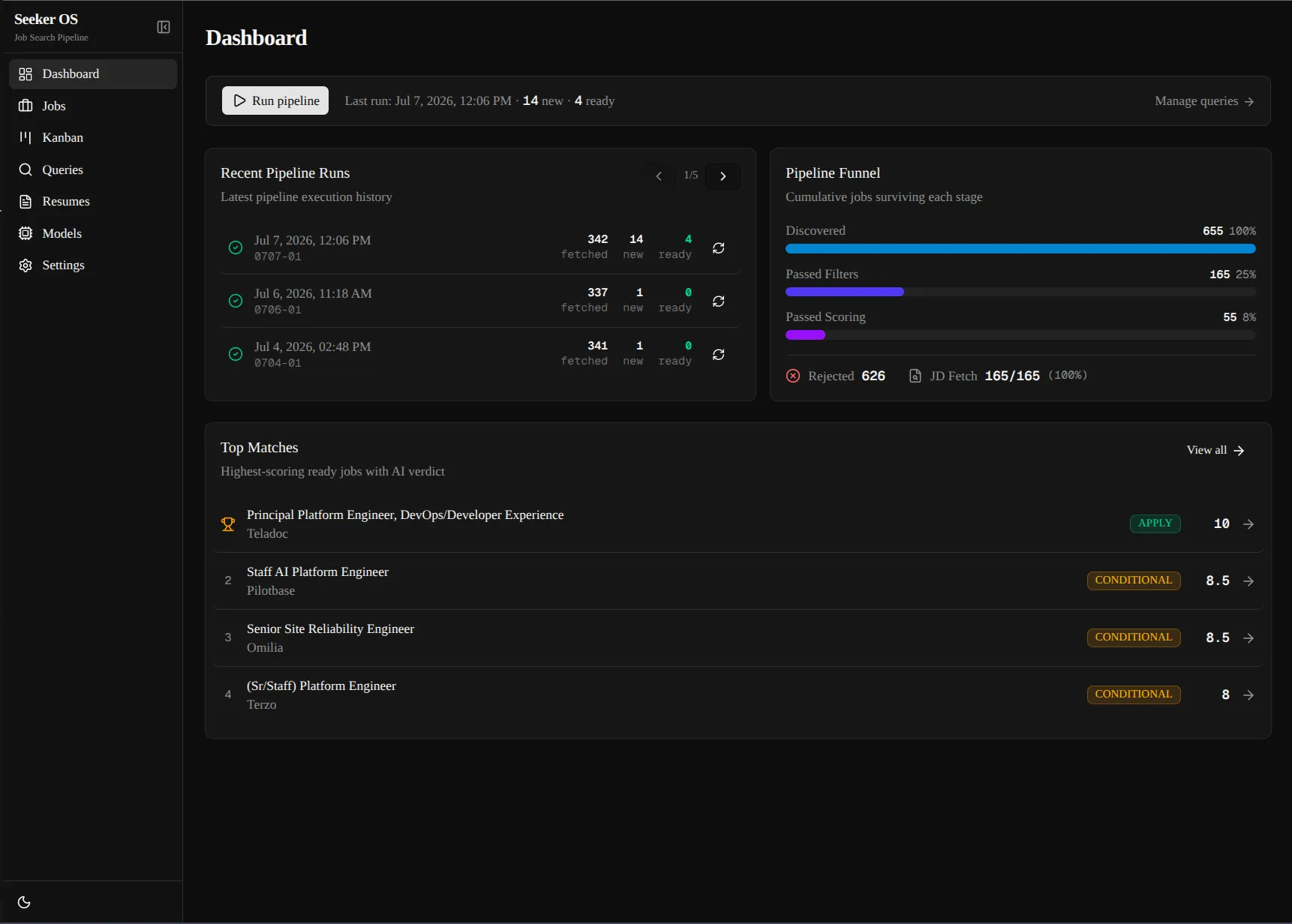
A structured, dashboard-driven job search pipeline — discovery, config-driven scoring, LLM analysis, and tailored document generation — and a working study in where you let an AI act, where you check it, and where you forbid it.
The interesting engineering isn’t that an LLM writes resumes; it’s that LLMs embellish, and a resume is a domain where embellishment is an integrity problem. So the trust boundaries are explicit:
- Claim-level accuracy enforcement. Every generated resume and cover letter passes a two-tier validator: deterministic deny-list checks, then LLM-judged claim traceability — every claim must trace to a source-of-truth master document or it fails with severity-tiered violations.
- Deterministic scoring firewalled from the LLM. Rubric scores are never injected into analysis prompts, so the reproducible signal can’t be contaminated by probabilistic output.
- Per-record AI authority. Each job carries a policy of allowed, draft-only, or forbidden — human-in-the-loop as designed governance, not a hope.
- Outcome-based calibration. An analytics endpoint joins rubric scores against real application events, measuring whether the scoring actually predicts anything.
Python/FastAPI and SQLite on the backend, Next.js dashboard, multi-provider LLM routing (Anthropic direct plus OpenAI-compatible, three model tiers with per-task overrides), YAML-driven configuration throughout, and an append-only event log for full auditability.